Description
The Study contributors are Jeronimo Escribano, Emanuele Emili and Carlos Perez from BSC, Kirsti Salonen and Angela Benedetti from ECMWF and Axel Lauer from DLR.
The main ECV datasets from the Climate Change Initiative used in this Study includes Aerosol, Cloud, Soil Moisture and Water Vapour.
The Study comprised of two parts. The first part focused on dust aerosol analysis with the BSC system. This involves constraining global dust aerosol simulations from the BSC MONARCH model with CCI data to produce dust analyses during the extraordinary event of June 2020. In the second part the aim was to undertake Cloud / Aerosol analysis with the ECMWF system. This involves joint assimilation of Aerosol and Cloud ECVs in the ECMWF IFS during June 2020 and September 2021 with the IFS 4D-Var scheme in CAMS configuration. In the optional phase of the study, results from both systems have been evaluated with the ESMValTool. ESMValTool is a Python-based community-developed software package for evaluation and analysis of climate model results with observations. ESMValTool has been extended to support processing the output from IFS and MONARCH directly without the need of reformatting the data beforehand. As a demonstration, the model results have been compared to daily data from Aeronet station measurements and CLARA-AVHRR as well as ESA CCI AEROSOL (SLSTR) satellite data.
Results and conclusions
The Barcelona Supercomputing Center (BSC) produces daily forecasts of airborne mineral dust for the World Meteorological Organization’s Barcelona Dust Regional Center using the MONARCH model, which simulates the emission, transport and deposition of mineral dust.
In this part, a new source of satellite observations was tested for assimilation into the MONARCH model in order to improve the dust forecasts. The observations are aerosol optical depth (AOD) retrievals from the Sea and Land Surface Temperature Radiometer (SLSTR) aboard ESA’s Sentinel-3 satellites, processed within the European Space Agency’s Climate Change Initiative (CCI).
The assimilation was evaluated for the extreme “Godzilla” dust event of June 2020, during which a large Saharan dust plume crossed the Atlantic Ocean and reached the Caribbean. The SLSTR AOD observations were assimilated into MONARCH and the resulting analyses were verified against independent ground-based retrievals from the AERONET network of sun photometers.
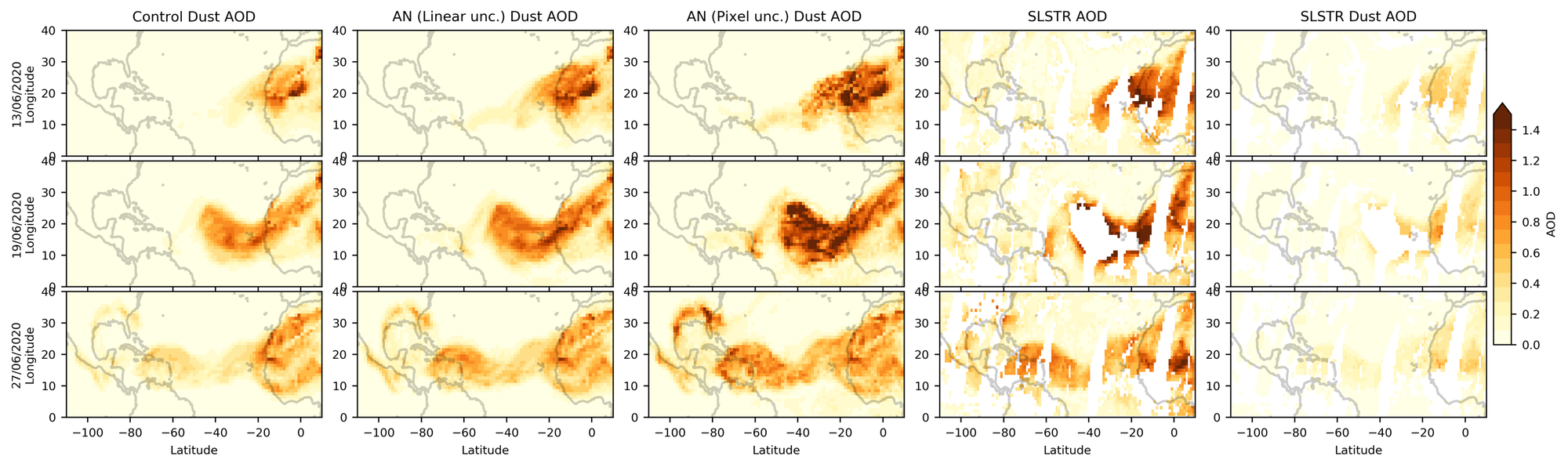
Assimilation of the SLSTR observations improved the dust forecasts. Figure 1 shows the control simulation dust AOD, the dust AOD analyses obtained with two different approaches for the observational uncertainty, and the SLSTR AOD and SLSTR dust AOD for three selected days of June 2020; the analyses reproduce the strength and timing of the dust plume and its arrival over the Caribbean more accurately than the control run. The results are consistent with earlier experiments based on other satellite instruments, carried out in ESA’s DOMOS project, confirming that SLSTR data are a valuable addition for dust forecasting. A complementary comparison of monthly averages performed with the ESMValTool software leads to the same conclusion.
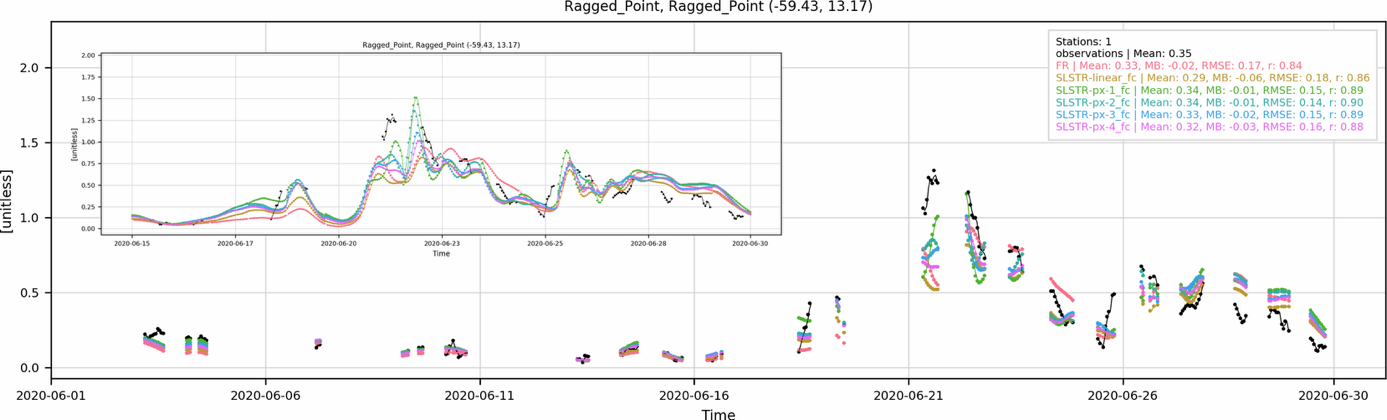
As for any observation, the SLSTR retrievals carry some uncertainty. Figure 2 shows time series of coarse-mode AOD from AERONET retrievals and from the model forecasts at Ragged Point (Barbados Islands) for the control run (FR) and five experiments (SLSTR-*) using different assumptions on the observational uncertainty; a careful treatment of this uncertainty, particularly over the ocean, was found to give the best results.
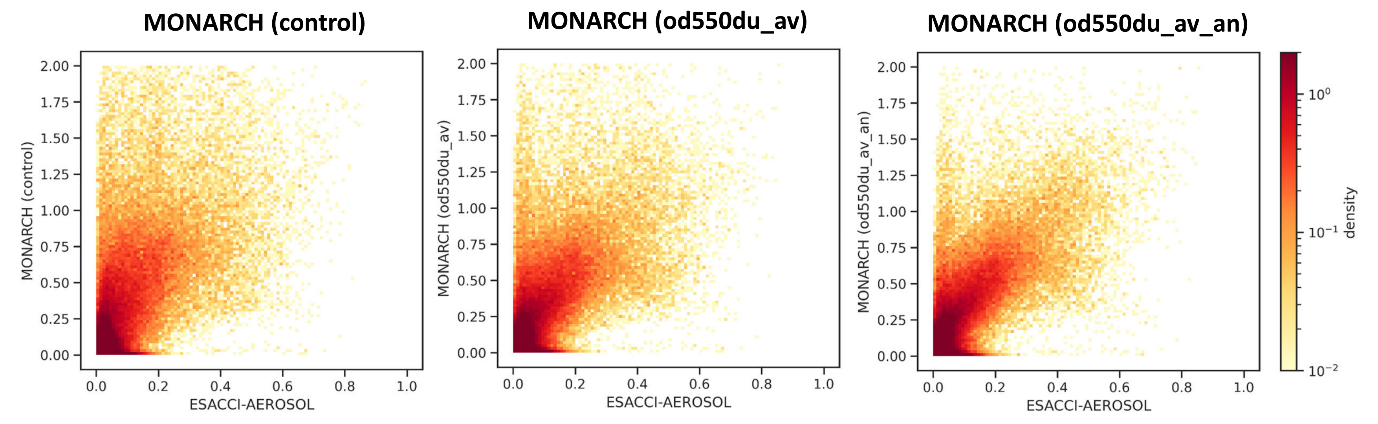
Changes in the distribution of the modeled global daily dust AOD values compared with ESA-CCI data (Figure 3) are consistent with these findings and show a reduction when dust AOD is used in the assimilation. The reduction is particularly visible in high dust AOD values.
Overall, the results show that SLSTR AOD observations can be assimilated in an operational forecasting system to produce better dust predictions. Continued development of these satellite products is recommended, as it would bring further improvements to dust forecasting and to the early-warning services that depend on it. Improvements of the dust optical depth, which has been found to be underestimated in ESA-CCI product, could significantly benefit dust forecasts and more in general improve discrimination capabilities within aerosols assimilation systems.
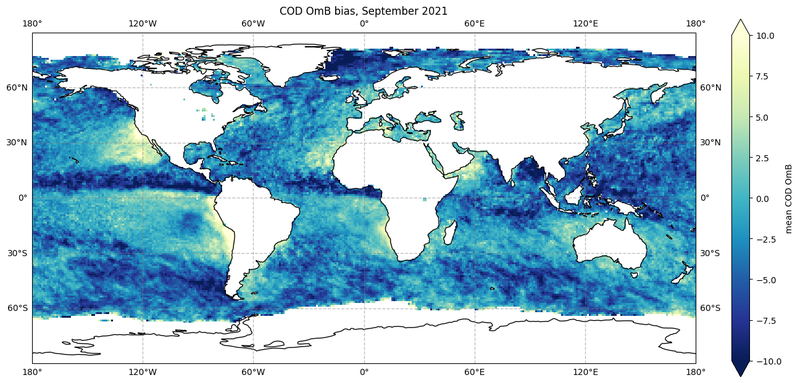
Data sets for aerosol optical depth (AOD) and cloud optical depth (COD) from Sea and Land Surface Temperature Radiometer (SLSTR) have been evaluated and tested for assimilation in the ECMWF 4DVar system. While AOD observations from other instruments are operationally used in the Copernicus Atmosphere Monitoring Service (CAMS) configuration, CODs are a new source of information and provide an interesting avenue for assimilation of cloud information into the system. Figure 4 shows observation minus model background (OmB) mean difference from a passive monitoring experiment for CODs. The statistics indicate positive mean difference over regions where there is typically persistent marine stratus. Negative mean difference on the other hand is seen in the inter-tropical convergence zone. The results are in line with similar monitoring done for Ocean and Land Colour Instrument (OLCI) reflectances, indicating that the mean differences would originate from the lack of stratiform clouds in the model rather than an observational or retrieval problem. Monitoring of the CCI SLSTR AOD observations indicates good and homogeneous data quality over sea, except the regions where bias related to desert dust is present.
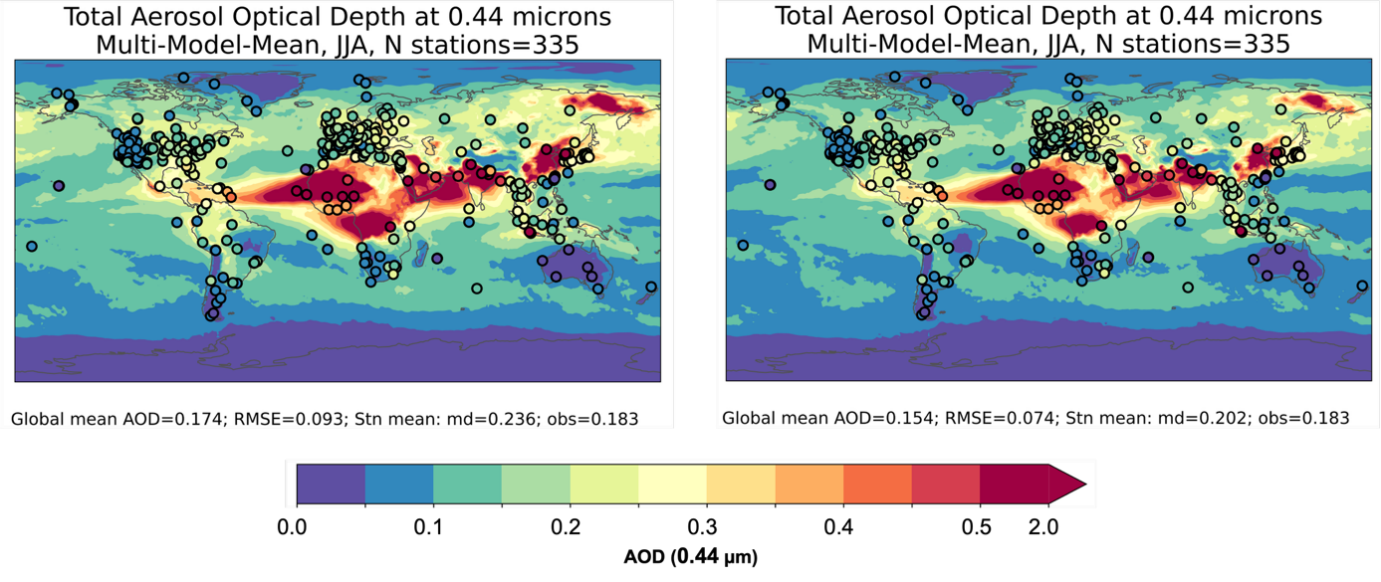
Impact assessment performed indicates that assimilation of the CCI AODs generally has a positive impact. Figure 5 shows the aerosol optical depth at 0.44 mm, the left panel is for the CTL experiment and the right panel for the AOD+COD experiment. The shading indicates the model fields and the circles are the AOD observations from the Aeronet network. Assimilating the AOD and COD observations into the ECMWF IFS-COMPO system improves the root mean square error for AOD and overall, the model fields are in good agreement with the Aeronet AOD observations.
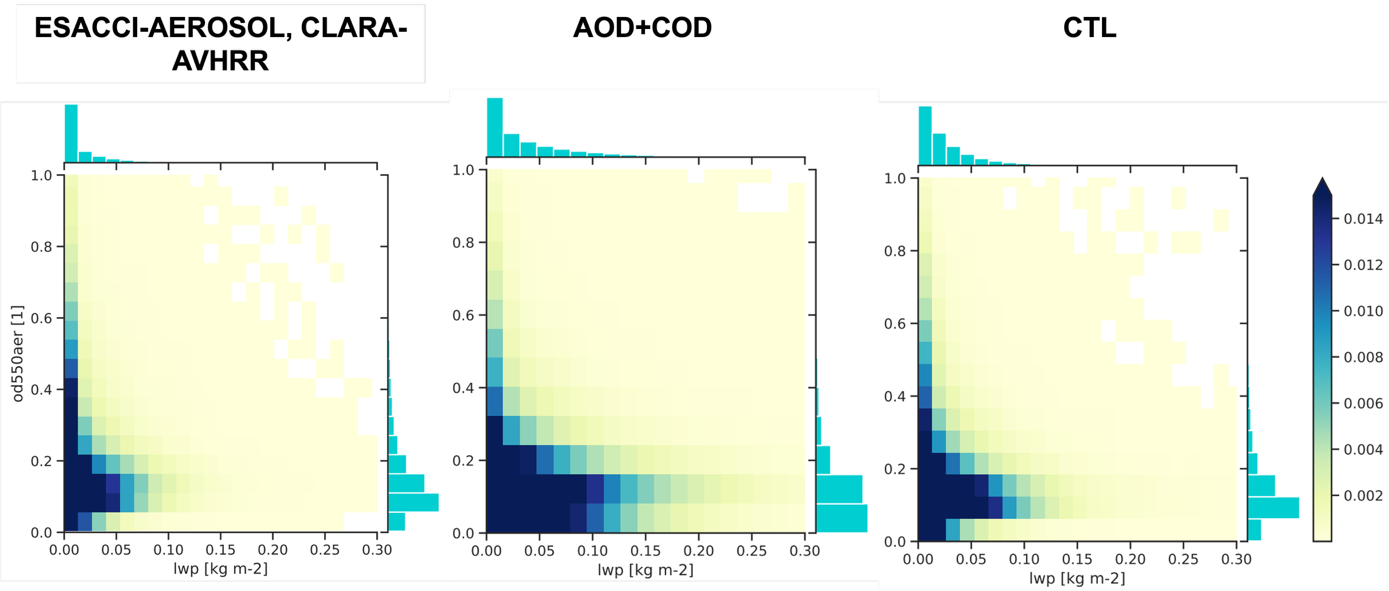
Impact on cloud related variables is more mixed. Figure 6 shows the distribution of LWP vs AOD values for CLARA AVHRR and ESA CCI AOD (left panel), model LWP and AOD from the AOD+COD experiment (middle panel) and model LWP and AOD from the CTL experiment (right panel). The distribution of LWP vs AOD values is closer to observations in the CTL experiment compared to the AOD+COD experiment. Also evaluation against radiosonde temperature and humidity observations indicates degradation.
The COD product was tested in assimilation for the first time. Thus, no similar maturity can be expected than with the AOD product. There are several suggestions how the impact of the COD assimilation could be improved from these first trials. First, the quality screening of the data could be made stricter. In these experiments we did not perform sensitivity tests with the first guess check where the observed value is compared to the model counterpart and rejected if they deviate too much. Second, the monitoring statistics indicate significant biases over some areas. Thus, implementing variational bias correction for the COD assimilation could be beneficial. Third, developing more sophisticated observation error model could be beneficial.