

Ten major climate developments have been highlighted in the 2026/2027 edition of the 10 New Insights in Climate Science report. Produced by more than 70 scientists from nearly 30 countries, the annual synthesis translates complex research into accessible, concise insights to inform high-stakes decisions.
Published today, the report warns how overshooting 1.5°C of warming carries rapidly escalating risks of irreversible impacts for oceans, glaciers, and permafrost, with consequences for livelihoods and economic activity for decades to come.
"The evidence is unequivocal: 1.5°C is a limit that we cross at our own risk. Beyond it, the risks of cascading and potentially irreversible climate impacts increase, with every additional tenth of a degree making them more severe," warns Johan Rockström, director of the Potsdam Institute for Climate Impact Research and co-chair of The Earth League.
A joint initiative of Future Earth, The Earth League, and the World Climate Research Programme, the 10 New Insights highlights how sea-level rise and ocean warming is irreversible on century-timescales due to past emissions, but that the ultimate magnitude still depends strongly on how quickly the world cuts greenhouse gases.
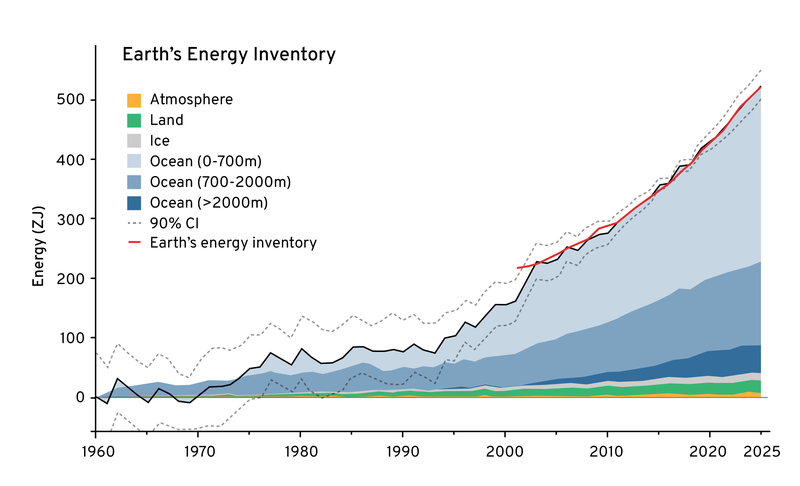
"The ocean has been our planet’s shock absorber. Because heat takes decades to penetrate ocean depths, today's emissions effectively lock in further warming and sea level rise," explains Wendy Broadgate, Global Hub Director at Future Earth and editorial board member. "Deep, rapid emissions cuts are the only way to limit these risks."
Scientists working through ESA's Climate Change Initiative contributed as authors and reviewers on the report (and journal article in review). Satellite observations and long-term global climate records also informed several of the report’s findings, helping to translate space-based evidence into knowledge for climate decision-making purposes.
For more information, watch the webinar recording below from 6 October, where editorial board members provide a more in-depth look at some of the insights.
The full list of insights for 2026/2027
- Ocean heat uptake: The ocean continues to absorb record amounts of heat, locking in further warming for years to come and increasing climate risks. Deep emissions cuts are critical to slow this.
- Accelerating sea-level rise: Melting glaciers and ice sheets are driving rising seas. Some change is already irreversible, but rapid mitigation can still limit future rise.
- Continental drying: Climate change and growing water use are causing the rapid loss of freshwater across continents, threatening water security, ecosystems, and food production.
- Impacts of overshooting 1.5°C: The further warming rises above 1.5°C, and the longer it stays there, the greater the risk of irreversible impacts and the more emissions cuts, carbon removal, and adaptation will be required.
- Food systems are key levers: Transforming food systems, particularly through more plant-rich diets, can deliver major benefits for climate, biodiversity, and health, but must be done carefully and fairly.
- The true social cost of carbon: The economic damages caused by carbon emissions are substantially higher than previously estimated, and every extra ton of CO2 carries additional risk.
- Attributing climate impacts to emitters: Advances in attribution science now allow linking the emissions from specific actors to specific climate impacts, strengthening the evidence available for accountability, litigation and loss and damage.
- Fair and effective climate clubs: Linking climate action to trade measures can encourage decarbonization, but the same measures may also impose disproportionate costs and challenges on developing economies.
- Climate obstruction: Intentional efforts to delay climate action have evolved from science denial toward subtler tactics, including greenwashing, misleading solutions, and spreading digital disinformation at scale.
- Geopolitics and the energy transition: Geopolitical instability can accelerate the clean-energy transition for some countries, while deepening fossil-fuel reliance for others, with growing risks of an unequal global transition.