

Tropical forests are vital carbon sinks, yet a surprising threat has been uncovered: the clearance of small areas of forest – often less than two hectares – is responsible for over half of net carbon losses across the tropics.
Yidi Xu and Philippe Ciais from the Laboratory for Climate and Environmental Sciences, along with their team, who are contributing to ESA Climate Change Initiative’s RECAPP-2 and Biomass projects, used high-resolution satellite observations to reconstruct three decades of tropical forest carbon dynamics. Analysing data from 1990 to 2020, they found that these tiny forest clearances represent just 5% of the disturbed area yet drive 56% of net carbon losses. The study has been published in the journal Nature.
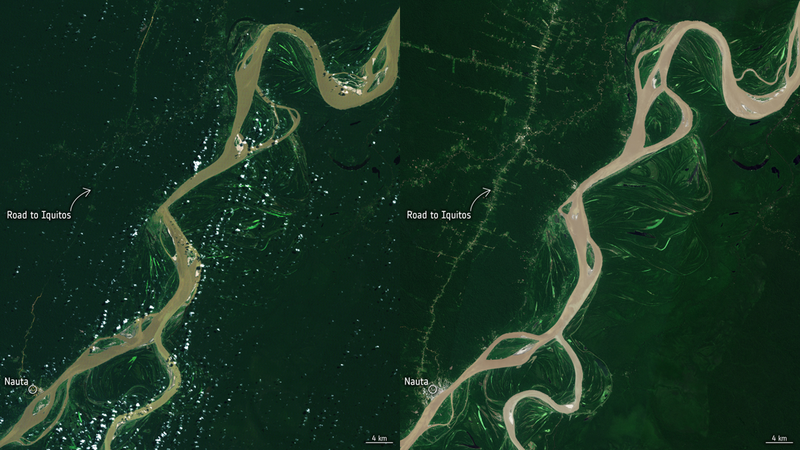
Most of these small clearings are not the result of dramatic clear-cutting or catastrophic fires, but rather the cumulative effect of modest human actions, such as expanding croplands, creating pasture and building roads. Unlike losses driven by fire, tropical humid forests altered by humans often fail to regrow, resulting in long-term emissions.
The results could reshape climate policy approaches, particularly in regions like Africa where curbing small-scale agricultural expansion could have greater impact than previously recognised. The study also provides governments and conservation planners with a powerful tool to improve carbon inventories and locate where targeted interventions are most needed.
Find out more about the study's further findings: https://www.esa.int/Applications/Observing_the_Earth/Space_for_our_climate/Tiny_patches_of_deforestation_drive_tropical_carbon_loss