

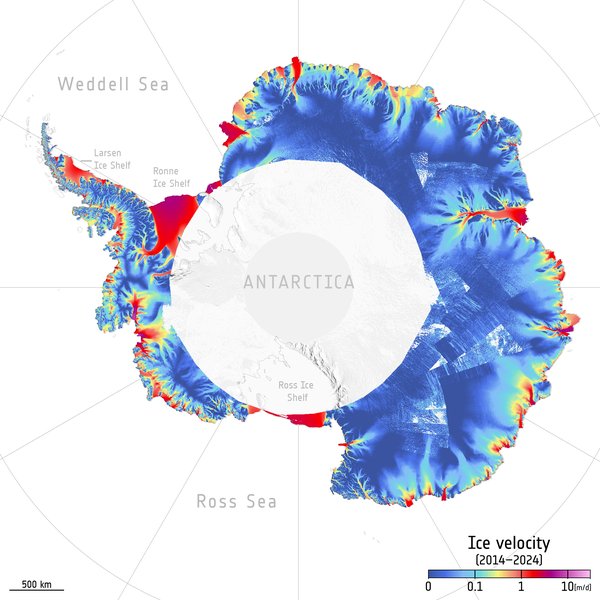
The Copernicus Sentinel-1 mission is celebrating its 10th anniversary, having provided continuous, high-resolution records of ice flow velocities across the Greenland and Antarctic ice sheets.
Ice velocity is a key parameter in measuring the effects of climate change – it reveals how fast glaciers and ice sheets discharge ice and water into the ocean, which is essential for predicting future sea-level rise.
A new study published in Remote Sensing of Environment, as part of a special collection of academic papers marking the mission's 10th anniversary, presents this long-term all-weather dataset based on advanced processing of Sentinel-1 radar data. The findings reveal significant changes in ice dynamics: on the West Antarctic Ice Sheet, the velocity of the Pine Island Glacier at its grounding line – where grounded ice detaches from bedrock and becomes a floating ice shelf – increased continuously from 10.6 to 12.7 metres per day. In Greenland, the Jakobshavn Glacier remains one of the world's fastest outlet glaciers, reaching speeds of up to 50 metres per day.

The dataset, with, unprecedented spatial detail at resolutions of 200–250 metres, not only reduce uncertainties to better predict change in future sea-level but also offers critical insights into the stability of polar ice sheets and their role in global climate dynamics. With the launch of Sentinel-1D at the end of 2025, the mission now provides acquisitions every six days or less over polar regions.
The current phase of the Antarctic Ice sheet CCI project is adapting existing ice velocity retrieval algorithms to further enhance ice flow monitoring capabilities, including increased data coverage and temporal resolution, and prepare for upcoming new synthetic aperture radar (SAR) satellite missions such as ROSE-L.
Read the full story: ESA - Sentinel-1's decade of essential data over shifting ice sheets